
Meet Troy Stecher, the newest Maple Leafs cult hero: ‘A man of no fear’
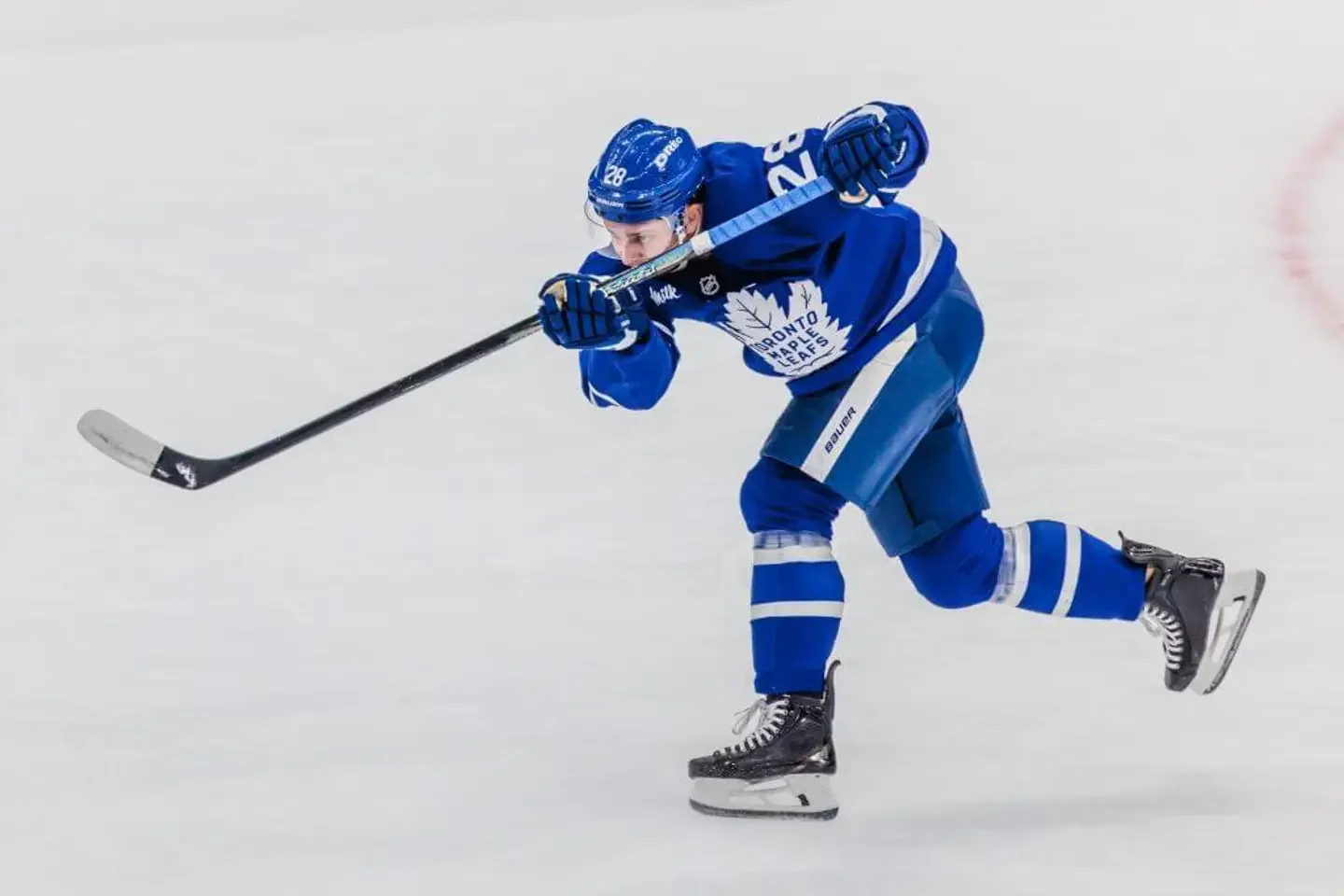
The Maple Leafs have the seventh-best points percentage in the NHL since picking up Troy Stecher in mid-November. Mathew Tsang / Icon Sportswire via Getty Images
By Joshua Kloke
Jan. 13, 2026 3:13 am PST
In the dead of winter in Grand Forks, N.D., Troy Stecher wouldn’t stop barking at teammates.
The University of North Dakota Fighting Hawks believed they were the top college hockey team in February 2016. But the University of Denver had just served them their first back-to-back losses of the season. The team cancelled a Valentine’s Day party as a result. During their first practice following the losses, Stecher heard teammates moaning about how they should be sleeping off fun from the party instead.
And so the defenseman got to work: he finished checks with force. He slammed his stick in puck battles with authority. And he shouted at teammates to do the same, even if that meant hurting their feelings.
What mattered to Stecher was winning a national championship.
“We had multiple fights in practice,” former North Dakota and NHL winger Drake Caggiula said. “Everyone was pushing to get to another level and Troy embodied that. He was the guy pushing buttons to raise the intensity level.”
Following that practice, North Dakota lost just one of their final 14 games of the season en route to winning the NCAA National Championship game. They would not have done so without an undersized defenseman with an oversized drive.
“With the way (Stecher) plays the game, it’s like, you either get on my level or you get out of the way,” Caggiula said.
It’s an attitude the undrafted Stecher has used to grind out 592 regular-season NHL games with seven different teams. And it’s an attitude that is seeing Stecher turn his latest stop, after being claimed on waivers by the Toronto Maple Leafs, into arguably his most memorable.
Few expected Stecher to adapt to Toronto so quickly. A waiver claim should not have been the Leafs’ answer to their blue-line woes. But Stecher has become an irreplaceable part of the back end. Since the Leafs acquired Stecher on Nov. 15, they have the seventh-best points percentage in the NHL.
His defensive efforts have been tremendous. He’s rallied an oft-sleepy crowd. And there’s infectious swagger. He winked at a camera during his last appearance on “Hockey Night in Canada.”
Despite being the smallest Leafs defenseman, Stecher is becoming a cult hero in Toronto.
The latest chapter in Stecher’s story is like many before: a person bettering those around him, and a player fighting for every opportunity he gets.
“On the ice and off the ice, I mean this,” Caggiula said, “he’s a man of no fear.”
Fred Harbinson’s scouts told him about a 16-year-old Vancouver-based blue liner worth a look. And so the GM and coach of the Penticton Vees arranged a breakfast meeting with Stecher, knowing little about him.
The morning of the meeting in 2010, Harbinson looked out the window of the restaurant to see Stecher arrive. Immediately, he felt regret.
“I was praying to God this wasn’t the kid because he looked like he was 12 years old,” the square-jawed Harbinson said. “And you’re thinking, ‘oh no.’”
Harbinson made an assumption many have made about Stecher: He’s too small to play defense.
As they tucked into their eggs, Harbinson backpedaled and floated the idea of Stecher playing junior B instead of in the BCHL, a junior A league.
Stecher had also been drafted by the WHL’s Portland Winterhawks, but was told after his first training camp he should play next season in junior B instead. But he craved the highest level. He learned the Vees had multiple NCAA commits.
“Troy looks at me and says, ‘Oh no. I’m going to make your team this year,’” Harbinson said.
The next day, Harbinson watched Stecher play and saw what his scouts saw: ceaseless energy. A willingness to engage in puck battles. A fearlessness moving the puck up the ice. All with a meager frame and build.
“In his mind, he’s 6-foot-4,” Harbinson said. “I think he actually believes it.”
He made the Vees and his first season in Penticton, the young Stecher committed to the University of Nebraska at Omaha. Yet through his two seasons at Penticton, the coaches at Nebraska who recruited him either left or retired. He felt no connection with the new staff and de-committed. Stecher didn’t have a fallback option.
“I lost contact because I had nobody in my corner,” Stecher said.
That could be because Stecher wasn’t sprouting as tall as his peers. It hardly bothered him.
“It’s not so much that I have to prove people wrong, it’s more about proving myself right,” he said.
Stecher knows the way people talk about him. But he’s proud that intensity defines him.
“I’m wired that way,” Stecher said. “My dad would always harp on me, saying, ‘You can only control your work ethic and your attitude.’”
Both of those elements were on display in Stecher’s second BCHL season. The Vees won the Royal Bank Cup as the best junior A team in Canada. Stecher was named top defenseman.
“You could see how talented he was, but it was always about his heart,” Harbinson said. “If he was going up against a guy twice his size, he’d come out with the puck.”
The Vees returned to the BCHL final the following season. Yet in Game 1, Stecher suffered a separated shoulder. He kept the excruciating pain under wraps and continued playing.
“I don’t know how it was humanly possible,” Harbinson said.
When the Vees coaching staff learned of the injury, Harbinson remembers Stecher “begging” him to stay on the bench during the series. Harbinson relented, and did again when Stecher insisted on taking the ice.
“He ended up playing the rest of the series,” Harbinson said, his voice abruptly stopping in disbelief.
Stecher’s size and lack of point totals left him off NHL Central Scouting’s final rankings for his draft year in 2012. He went undrafted and returned for one more BCHL season.
After the season, Harbinson called Dave Hakstol, then the coach of the University of North Dakota.
“Dave, trust me,” Harbinson remembered saying. “If you take him, the way he plays all week in practice, he’s going to embarrass you if you don’t put him in your lineup on Saturdays.”
On one of Stecher’s first visits to the North Dakota campus, he again made an awkward first impression.
“A pretty boy coming from Penticton,” Caggiula said. “He was the big defenseman in the BCHL and he came in with the long hair and the sweater vests and polo shirts. At North Dakota, we wear sweatpants and hoodies.”
Caggiula said many on the team wondered if Stecher would ever be a good fit. It took all of one practice for Stecher to remind his new teammates of the harm in judging people early.
Stecher yapped before practice, speaking with the ease of an old friend. And on the ice, he played with intensity that nullified his small frame.
“Here we are pigeonholing him as a guy that’s not going to fit in and then in his freshman year he fit in like a glove,” Caggiula said.
Stecher did so by unleashing a team-first attitude that has stayed with him to this day. Dinners, parties, workout sessions after practice: if there were teammates involved, Stecher was there. There were no lone wolves in Stecher’s pack. Camaraderie was a precursor to winning.
When a wide-eyed Brock Boeser showed up to North Dakota, he said Stecher “took me under his wing.” Now a star with the Vancouver Canucks, Boeser believes his college career might not have been successful had Stecher not showed him the ropes.
“He’s never on his own page,” Caggiula said. “He’s always on the team schedule.”
When the schedule called for practice, Stecher was at his best. Winning the puck from teammates felt like his reason for waking up in the morning. That’s why the coaching staff consistently gave Stecher more ice time through his three years in North Dakota, culminating with the national championship.
Stecher has now played more NHL games than the five defencsmen ahead of him on the North Dakota depth chart in his freshman year combined — all of whom were drafted to the NHL.
“(Stecher’s) work effort is contagious,” Caggiula said. “For him, every day is a battle. And then, all of a sudden, he’s at the same level as a defenseman who is more skilled.”
Less than a week after the national championship win, Stecher signed with his hometown team, the Vancouver Canucks, as a free agent. Stecher hit the ground running and became a regular bottom-four defender. He battled his way to his second NHL contract, a healthy two-year deal with a $2.325 million AAV.
Teammates loved him. Despite being young and unproven, Stecher joined the Canucks’ card table, often full of veterans.
Little-known fact about Stecher: he’s a card shark. The Canucks played euchre during his tenure. He formed a partnership with Boeser.
“I always felt euchre was a game of chance,” said Sam Gagner, a teammate of Stecher’s over three teams including the Canucks. “But Stecher and Boeser won all the time, because Stecher can read people.”
Life was good. Or so Stecher thought.
Despite being a key contributor on a Canucks team that went deep in the 2020 postseason, then-Canucks GM Jim Benning did not extend a qualifying offer at the conclusion of Stecher’s second contract. The Canucks faced a cash crunch.
“He needed to fight for a job and work his ass off,” Boeser said of Stecher’s Canucks tenure. “That’s been the story of his whole career.”
Stecher learned the business of the league. He took a pay cut and signed a two-year deal with the Detroit Red Wings.
It was the beginning of a turbulent few years. Starting in 2021-22, Stecher would make seven different stops over the next five seasons. He could never latch onto a team.
“It was for sure a size thing,” Gagner said of Stecher not sticking with a team full-time. “The way the league’s trending, teams are looking for size on the back end. Players like Troy get looked over.”
With every deal he signed, Stecher’s salary dropped. Quietly, he wondered how long his NHL career would last.
“There were times when he wasn’t in the lineup and that can be very tough for a player,” Gagner said. “But every night he’s in the lineup he gives you everything he has. As a player that really gives a lift to the group.”
With the Edmonton Oilers, it did. Stecher was traded to Edmonton at the 2024 trade deadline and then re-upped on a two-year deal.
“Troy is one of my favorite players that I’ve played with,” Oilers forward Zach Hyman said. “He never complains.”
Stecher was playing regularly. In 2025, the Oilers looked primed for another run toward the Stanley Cup. Stecher was willing to do whatever it took to achieve that goal.
Hyman remembers overhearing a conversation between Stecher and then-Oilers assistant coach Paul Coffey as the trade deadline approached.
“(Stecher) was saying, ‘I want our team to win. Above all else, I don’t care if I don’t play, if there’s somebody that’s going to help the team more than me, put them in and I’m happy to just be a great teammate, work and just grind,’” Hyman said. “He was playing well but was willing to sacrifice his spot.”
The Oilers acquired Jake Walman at the trade deadline. Stecher played just eight of 22 playoff games. But he was one of the first on the ice for morning skates and practices, pushing teammates to improve.
“You just don’t see that genuine selflessness,” Hyman said. “You hear about it. But to actually truly mean it, he’s the guy who embodies that.”
Hyman began the year recovering from wrist surgery. He skated with Stecher, again in and out of the lineup. Hyman became addicted to those skates.
“(Stecher) just brought this positive attitude. He’s a big reason why I’m back to playing and playing well is because he would battle with me every day,” Hyman said.
Yet on the same day Hyman returned to the lineup, the Oilers waived Stecher.
The Leafs needed an NHL player with injuries besetting their blue line. They took a chance on Stecher.
“He was low,” Boeser said of his friend. “For him, it was like, ‘I’ve got to make it or else I’ve got to go to Europe.’”
Stecher arrived in Toronto and thought of his dad’s advice. He decided not to tip-toe through what could be his final NHL opportunity.
He practiced with heightened energy; who cares what others thought of him? He played like every shift was his last. And he again broke protocol and entered the Leafs’ card game on flights immediately. Most players wait a full season before grabbing a spot at the table. But Stecher wanted to be part of the group. He pulled rank via games played and gave a younger Leaf the boot, making them sit on a cooler in the aisle of the plane. Stecher won’t say who — he’s a good teammate, after all.
Multiple recent mid-season Leafs additions, like Scott Laughton, struggled when first joining the team. They required time to acclimate to a team with heightened expectations.
But Stecher’s adaptation has been smooth. You wonder if his approach has brought the best out of some once-sleepy Leafs additions.
“(Stecher) has scratched and clawed his way through it,” Laughton said. “That mindset he had coming in has helped him fit in with the group really well.”
Stecher’s experience in powder-keg NHL markets like Vancouver and Edmonton helped him understand how to make it work on short notice in Toronto.
Be yourself. And nothing will impress onlookers more than work ethic.
Stecher is logging over 20 minutes a night on average for the first time in his career. He’s become crucial to one of the league’s best penalty kills. And through 26 games heading into Monday night in Colorado, he led all regular Leafs with the best five-on-five expected goal share (54 percent), per Natural Stat Trick.
Stecher’s work ethic makes it easy to see him playing playoff hockey, should the Leafs qualify. Their chances are better because of Stecher — and who he became on his long journey to Toronto.
“It’s hard to give yourself credit,” he said, “but the one thing I’ve given myself credit for is being true to myself.”